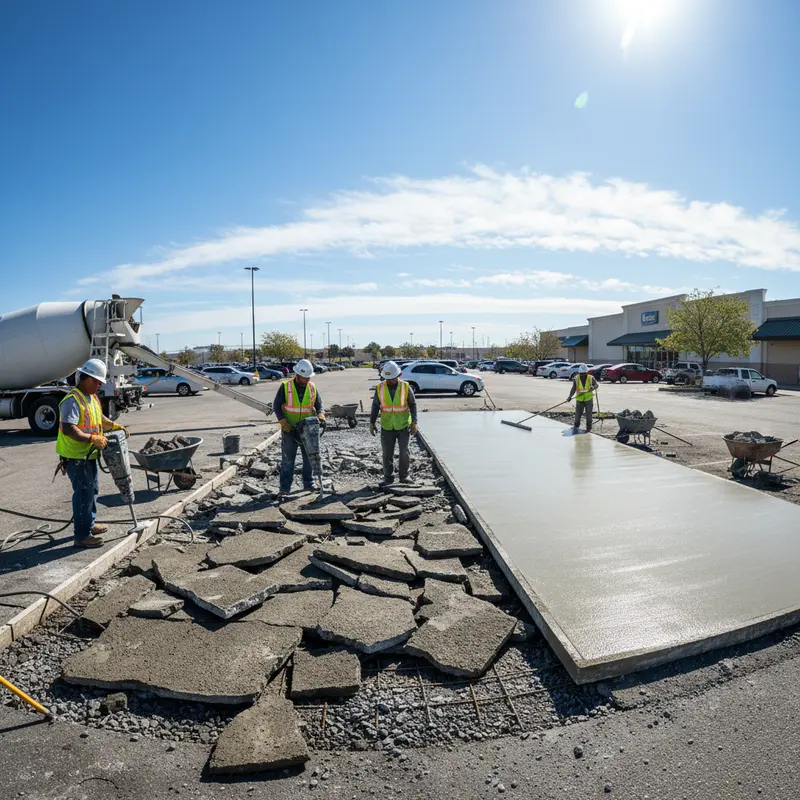
Targeted repair costs less, but it only works when the slab base is still sound. Here is how to tell whether your commercial concrete lot needs panel-level repair or full replacement.
Two Very Different Projects
When a commercial concrete lot starts to look rough, owners face a common question: repair the failing sections, or tear it out and replace the whole thing. The two projects sit at very different price points, and choosing wrong is expensive either way. An unnecessary replacement wastes money. A patch placed over a failed base cracks again within a season and wastes even more.
Targeted repair takes out the failing panels or curb sections, prepares the subgrade where needed, and pours new concrete that ties back into the surrounding slab. It restores function and trip safety at a fraction of the cost of a full job. Full replacement removes the entire slab, often along with the base, and rebuilds the section from the subgrade up.
The deciding factor is almost always the condition of the base beneath the concrete. The surface you can see tells only part of the story. What is happening underneath determines which project you actually need.
When a Targeted Repair Is the Right Call
Targeted repair is the smart, economical choice when the base under the slab is still structurally sound and only specific panels or curb sections have failed. If most of the lot is in fair condition, panel-by-panel work can give it many more years of service without a wholesale rebuild. A few cracked or tilted panels, a couple of broken curb stretches, and an otherwise stable slab are typical signs.
Look for cracks that are still isolated rather than connected across the lot, and panels that sit level and stable except in a handful of spots. Curb sections often fail at known stress points like inlets or driveway returns. In these cases the slab structure is fine and only certain elements have reached the end of their useful life.
Before any panel pour, the existing subgrade under the failed area has to be prepared properly. That means removing the broken concrete cleanly, addressing any soft spots or moisture issues underneath, and tying reinforcement into the surrounding slab so the new pour stays in plane. Our commercial concrete paving crews handle that prep so the repair performs the way it should.
When You Need a Full Replacement
Full replacement becomes the better value when the base itself has failed under widespread sections of the slab. The clearest sign is cracking that has spread across most of the lot in a connected pattern, with panels that have settled, heaved, or pulled away from each other on a large scale. When the base is moving or breaking down beneath a wide area, anything new placed on top inherits the same failure.
Other signs include slab edges that have crumbled along long runs, multiple curb sections that have settled out of grade, and patched areas that have failed again after being repaired. When repair becomes a yearly ritual, the underlying base has usually decided the question.
Replacement costs more up front, but with a properly rebuilt subgrade and base the new concrete has a stable foundation and a long service life ahead of it. For a property owner planning a budget, an honest base assessment is what prevents paying for panel repair now and a full replacement again in two years. Owners with industrial property in areas like Garland often need replacement sections simply because the original slab was never built for the truck loads it now carries. Our commercial concrete flatwork teams can pair a replacement with the curb, gutter, and sidewalk work that usually goes with it.
How We Tell the Difference
Knowing which project a lot needs starts with a real site review, not a guess from the parking lot entrance. We walk the property, map the distress, and pay close attention to the patterns that reveal base condition.
We look at how cracks are behaving, whether failed panels are isolated or trending toward each other, how the lot drains, and how patched areas have held up. Where the picture is unclear, the condition of the subgrade can be confirmed directly. We also factor in what the property actually needs to carry, because a lot that has outgrown its original traffic may need a stronger section even if the old one has not fully failed yet.
The result is a straightforward recommendation with an itemized estimate. Sometimes the answer is a mix, with most of the lot getting panel-level repair and a few failed sections getting full-depth replacement. That hybrid approach is common and often the best value. We would rather give an honest assessment than sell the bigger job, because a recommendation a property owner can trust is worth more than one project.
Plan the Project Around Your Operations
Whichever route a lot needs, the project has to work around a functioning business. A parking lot is rarely something a commercial property can simply close for a week, so phasing is part of every plan we build.
We sequence the work so sections of the lot stay open while crews work the rest. We also schedule around business hours when a property needs it, including nights and weekends for retail and industrial sites. Fresh concrete needs time to cure before it carries vehicle traffic, so the schedule accounts for that too.
Good planning also means coordinating related work. If the lot needs panel replacement and the property also needs new curb, gutter, or sidewalk work, doing both on one coordinated schedule saves time and disruption. To have a lot evaluated and get a clear repair-or-replace recommendation, contact our estimating office.
Frequently Asked Questions
How much cheaper is repair than full replacement?
Panel-level repair typically costs significantly less than a full replacement because it reuses the surrounding slab and base. The exact difference depends on lot size, the number of panels affected, and site conditions. We provide itemized estimates for both options when the choice is not obvious.
How long does a repaired panel last?
When the surrounding base is sound and the new pour is tied in properly, a replaced panel can last as long as the original slab around it. The lifespan depends on traffic, drainage, and how well the rest of the lot is maintained. A repair placed over a failing base, by contrast, can crack within a single season.
Can part of my lot be repaired and part replaced?
Yes, and this hybrid approach is common. Many lots have most of the area still sound enough for panel-level repair with a few isolated sections that need full-depth replacement. Our concrete crews map the distress and recommend the most cost-effective mix.
Will the project shut down my parking lot?
Not entirely. We phase commercial concrete work so sections stay open while crews work the rest, and we schedule around business hours when needed. Concrete also needs cure time before carrying vehicle loads, so we build the phasing plan with you during the estimate to keep your property open.