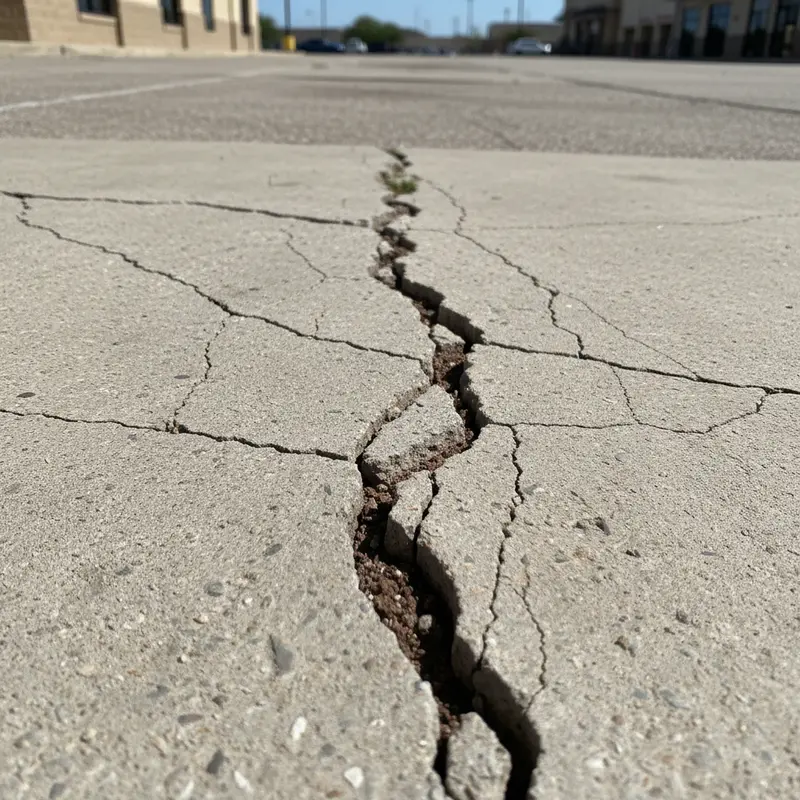
The expansive clay under most of the Dallas-Fort Worth metroplex is the number one reason commercial concrete fails early. Here is what every property owner should understand.
The Ground Under Your Concrete Is Always Moving
When a commercial concrete parking lot or sidewalk cracks within a few years of being poured, the surface usually gets the blame. Most of the time, the real problem is several inches below it. The expansive clay soil that sits under most of the Dallas-Fort Worth metroplex moves constantly, and that movement is the single biggest reason concrete here fails before its time.
Clay soil holds water, so when it rains the clay absorbs moisture and swells. When North Texas swings into a long dry stretch, the clay gives that moisture back and shrinks. A property can see several inches of vertical ground movement across a single year. Concrete is strong, but it is not built to flex with that kind of cycle, so slabs crack, heave, and separate instead.
This is not a rare condition. It affects commercial property across the entire region, from older retail corridors to brand-new developments. Understanding how it works is the first step toward building concrete that survives it.
How Clay Movement Shows Up on a Concrete Lot
Soil movement leaves a recognizable set of fingerprints on concrete. You see long cracks that run in irregular lines across slab panels, edges that have pulled away from curbs or buildings, and panels that have settled or tilted relative to their neighbors. Over time those cracks widen and connect, and the slab loses its ability to spread loads evenly across the subgrade.
On flatwork, the same movement lifts and tilts sidewalk panels, creating trip hazards where two slabs meet. It cracks curb and gutter so stormwater no longer drains the way it was designed to. It separates entry slabs from the building, and it cracks concrete slabs that already carry heavy daily traffic.
The pattern matters because it tells you whether you are looking at a surface problem or a base problem. Surface-level cracks can often be sealed and the panel kept in service. When the soil has moved enough to fail the base under the slab, our commercial concrete paving crews look at full-depth panel replacement instead. A surface treatment placed on a failed base just cracks again from below.
Why Drainage Is Half the Battle
If clay movement is driven by water, then controlling water is how you control the damage. Drainage is the most underrated part of commercial concrete, and poor drainage is the most common reason a North Texas slab fails early.
When a lot does not shed water properly, runoff pools on the surface and seeps down to the soil below. That keeps the clay wet and swollen in some spots while the rest of the property dries out, and uneven moisture means uneven movement. Uneven movement is exactly what cracks concrete.
Good drainage design sends water away from buildings and off the slab quickly, with positive slope toward inlets and no low spots where water can sit. We review grades and drainage at the start of every project, whether it is a new pour or a rehabilitation. For owners with property in fast-developing areas like Frisco, drainage planning matters even more, because nearby construction constantly reshapes how water moves across a site.
Building Concrete That Lives With the Soil
You cannot change the clay under a property, but you can pour concrete that is engineered to live with it. The work that protects a commercial slab happens before the concrete is ever placed.
It starts with the subgrade. Properly conditioning the soil to the right moisture content and compacting it gives the slab a stable platform. From there, the slab thickness has to match the loads the property will actually carry, because a section sized for light traffic will not survive delivery trucks. Reinforcement needs to be sized and placed correctly, and control joints have to land where shrinkage cracks should form rather than spreading randomly across the slab.
None of this is exotic. It is standard, careful construction, and it is the difference between a slab that lasts decades and one that needs help in five years. When the base is built right, our commercial concrete flatwork holds up to both the soil and the traffic. When the base is rushed, no surface treatment can save the pour.
A Maintenance Plan Protects the Investment
Even well-built concrete needs maintenance, because the clay never stops moving and Texas heat never stops working on exposed surfaces. The good news is that maintenance is far cheaper than replacement, and a small problem caught early stays small.
Crack sealing keeps water out of the cracks that do form, which slows the cycle of moisture reaching the base. Joint resealing keeps water from getting under panels at the edges. Panel-by-panel repair restores trip hazards before they spread, and curb section replacement keeps stormwater going where it was designed to go. Catching a failing area while it is still localized prevents it from spreading across the lot.
The owners who get the most life out of their concrete treat it like any other building system, with a schedule and a budget. If you manage commercial property across the metroplex, including sites in Dallas or Plano, a coordinated maintenance plan keeps every property on track. To have a property assessed, reach our estimating office for a property walkthrough.
Frequently Asked Questions
Does every commercial property in DFW have clay soil problems?
Expansive clay is present under most of the Dallas-Fort Worth metroplex, though the severity varies by location and depth. Almost every commercial property in the region is affected to some degree, which is why proper subgrade preparation matters everywhere. A site review tells us how aggressive the conditions are at a specific property.
Can you fix concrete that has already cracked from soil movement?
Yes. The right fix depends on whether the base is still sound. Surface-level cracking can be sealed and the panel kept in service, while panels where the base has failed need full-depth replacement. Our concrete crews assess the base during the estimate and recommend repair or replacement honestly.
How much does drainage really matter?
It matters enormously. Poor drainage is the most common reason a North Texas concrete lot fails early, because standing water keeps the clay wet and swollen. Correcting grades and drainage is often the highest-value part of a concrete rehabilitation project.
How often should commercial concrete be maintained?
Most commercial concrete benefits from a maintenance review every one to two years, with crack sealing and joint resealing on a schedule that fits the property's traffic and age. Heavily used retail and industrial sites need attention more often than low-traffic property.